Heat Treatment in Aluminium Casting: T5, T6, T7, Solution Treatment and Ageing
Mechanical properties in aluminium casting parts are determined not only by alloy chemistry and casting method, but also by the heat treatments applied after casting. In production that is predominantly aluminium sand casting, heat treatment — consisting of solution treatment, quenching and ageing steps — can significantly change yield and tensile strength, hardness and dimensional stability through the mechanism of precipitate hardening [1, 2]. However, heat treatment is not a “magic wand”: it cannot eliminate existing gas porosity or shrinkage cavities, and its applicability depends on the solvus behaviour of the alloy [1]. This review examines the T5/T6/T7 temper conditions, the F and O conditions, the solution treatment–quenching–ageing chain, Mg-Si precipitates and eutectic silicon morphology in the light of academic literature and international standards, with a focus on aluminium sand casting.
1. What Is Heat Treatment in Aluminium Casting?
Heat treatment is the controlled heating, holding at a specific temperature (soaking) and controlled cooling of a metal or alloy in the solid state in order to obtain the desired internal structure and mechanical properties [1]. In aluminium castings this process affects the volume (internal structure) of the part; it differs from processes that affect only the surface, such as sandblasting or grinding, and from joining processes such as welding. In this respect it falls into the class of volumetric/internal-structural processes.
Heat treatment of aluminium differs from that of steel: in steel, hardening relies on martensite formed by rapid cooling, whereas in aluminium casting alloys hardening is achieved by precipitation hardening [1]. Hardenability depends on the alloy containing a phase whose solubility changes with temperature; alloys that do not exhibit a solvus cannot be hardened in the classical sense.
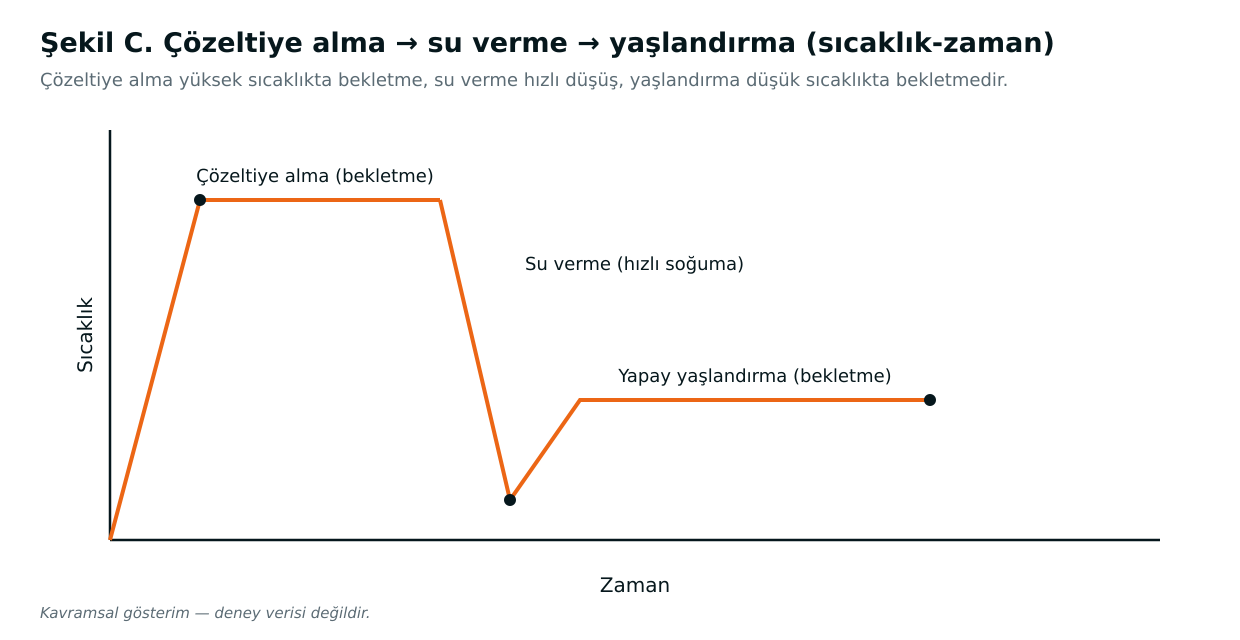
In aluminium sand casting alloys based on Al-Si-Mg and Al-Si-Cu-Mg, the typical heat treatment chain consists of three steps: solution heat treatment → quenching → ageing [1, 2]. When the entire chain is applied, T6 is usually obtained; when only an ageing treatment following the cooling from casting is applied, temper conditions such as T5 are obtained.
2. Purpose of Heat Treatment and Its Effect on Mechanical Properties
The primary purpose of heat treatment in aluminium casting is to increase yield/tensile strength and hardness through the controlled precipitation of hardening elements (Mg and Si in Al-Si-Mg), and also to improve dimensional stability and balance internal stresses [1, 7].
The mechanism is briefly as follows: the alloy is heated to a high temperature at which the hardening phases can dissolve (solution treatment); by rapid cooling the elements are retained in a supersaturated state in the solid solution; during ageing, fine, dispersed precipitates form and these hinder dislocation movement, raising the strength [1, 8]. The magnitude of the effect depends on the solution treatment temperature and time, the cooling rate, and the ageing temperature and time.
Heat treatment also affects eutectic silicon morphology (Section 13). The critical distinction here is that precipitation hardening (Mg-Si) and eutectic Si spheroidisation are different mechanisms; the former affects strength, the latter affects ductility/toughness [5].
The limit of heat treatment must also be clear: the process does not eliminate gas porosity or shrinkage cavities formed during casting [2]; therefore casting quality before heat treatment is decisive (Section 19).
3. Aluminium Casting Alloys to Which Heat Treatment Can Be Applied
Not every aluminium casting alloy responds to heat treatment to the same degree. Hardenability depends on the alloy containing a hardening phase whose solubility changes with temperature [1]:
- Al-Si-Mg alloys (for example A356/356 and the ETİAL-160 class): harden through Mg₂Si precipitates; this is the most common heat-treated alloy group in sand casting.
- Al-Si-Cu-Mg alloys (for example 319): harden with Mg-Si and Al-Cu based phases; can offer high-temperature strength.
- Al-Cu and Al-Zn-Mg based casting alloys: hardened by heat treatment in some aerospace applications.
- Near-eutectic Al-Si alloys (low Mg-Cu alloys such as A413/443): do not show pronounced precipitation hardening.
The engineering conclusion that follows is that a temper condition such as T6 cannot be generalised to all aluminium alloys [1, 6]. The appropriate temper for an alloy is determined by that alloy’s solvus behaviour and cast structure.
4. Microstructure, Solidification Rate and Dendritic Structure in Sand Casting
In aluminium sand casting, the low thermal conductivity of the sand mould produces slow cooling and a coarse microstructure [1, 7]. Compared with faster-cooling processes such as permanent mould casting or high-pressure die casting, secondary dendrite arm spacing (SDAS) is larger and microsegregation is more pronounced in sand casting.
As the cooling rate decreases, the dendrite arms (SDAS) become coarser. This is important for heat treatment; in a coarse dendritic structure, homogenisation of elements by diffusion requires longer times [1]. For this reason, solution treatment times in sand casting are generally kept longer than in thin-section permanent mould casting. In addition, needle-like intermetallic phases formed by impurities such as iron (Fe) during slow cooling adversely affect ductility and cannot be completely eliminated by heat treatment [7].
5. Solution Heat Treatment
Solution treatment is the heating–soaking step that enables the hardening phases formed during solidification (Mg₂Si in the Al-Si-Mg system) to re-dissolve in the solid solution and the structure to homogenise [1, 2]. It is typically applied at a temperature just below the solvus temperature of the alloy but below the incipient melting threshold.
This step has two important functions:
- Chemical homogenisation: diffusion of elements that segregated between dendrites during solidification.
- Microstructural change: partial spheroidisation/fragmentation of eutectic silicon and blunting of needle-like phases [5, 12].
The solution treatment temperature and time have a narrow process window. If the temperature is too low or the time too short, the phases do not fully dissolve and the ageing response remains weak; if the temperature is too high, low-melting eutectic phases locally melt (incipient melting) and cause permanent damage [9, 10] (see Section 15).
6. Quenching and Cooling Rate
Quenching is the rapid cooling step performed to retain the solution-treated elements in a supersaturated state in the solid solution [1]. If cooling is slow, the dissolved phases re-precipitate during cooling and the supersaturated structure required for ageing is lost, which lowers the final strength.
The cooling rate determines two opposing effects together:
- Mechanical properties: Faster cooling produces a more supersaturated structure with finer precipitates, increasing strength.
- Dimensional behaviour: Faster cooling creates a higher risk of residual stress and distortion in the part (Section 16).
Because of this balance, the quenching medium (cold water, hot water, polymer-based media) is selected according to the alloy and geometry; the risk of distortion increases in thick parts and complex geometries [1, 7]. Since the severity affects both strength and distortion/residual stress, there is no single “correct” rate; the process must be optimised.
7. Ageing: Natural and Artificial
Ageing is the step in which hardening precipitates are formed in a controlled manner from the supersaturated solid solution [1, 8]. There are two basic types.
Natural ageing
This is ageing that occurs spontaneously at room temperature. During this process atoms cluster (Guinier-Preston zones) and hardness gradually increases. The time to reach a stable state and the properties obtained vary greatly depending on the alloy and composition; in some alloys it takes hours, in others days or weeks, and in some casting alloys the natural ageing response remains limited. Natural ageing is associated with the T4 temper condition, which describes products that have been solution treated and aged at room temperature; however, not every alloy reaches the same stability in the same time, and the properties of T4 vary by alloy [6].
Artificial ageing
This is accelerated ageing carried out at a controlled temperature (the literature generally cites the 150-200 °C range) [1, 8]. Temperature and time are determined according to the targeted strength-ductility balance. T5, T6 and T7 include artificial ageing. Hardness reaches a maximum over time (peak ageing); after that, over-ageing begins (Section 18).
8. T5 Heat Treatment Condition
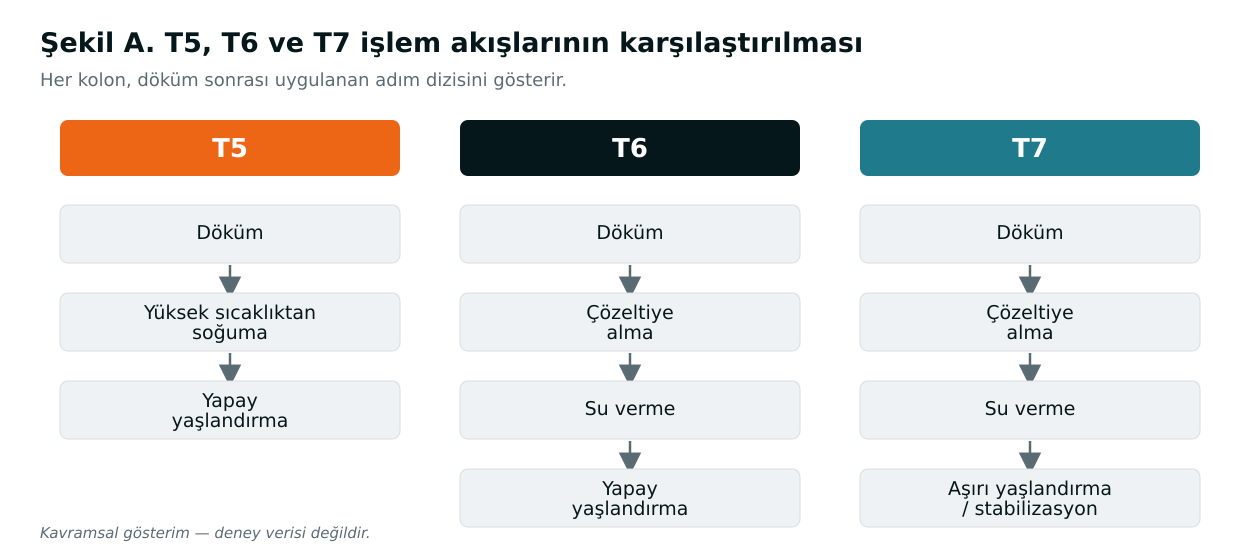
T5 is a temper condition in which artificial ageing is applied after cooling from a high-temperature production process (casting), but which does not include a separate solution treatment and quenching step [6]. Here the basis of hardening is the cooling after casting itself: thanks to rapid solidification and cooling, a significant portion of the magnesium and silicon already remains in the solid solution, and subsequent artificial ageing forms precipitates from this structure.
The engineering advantages of T5 are that, because it does not require a separate solution treatment and quenching step, the risk of distortion and the process cost are lower. In return, the strength obtained with T5 is generally lower than with T6, which is fully solution treated and quenched [1, 11]. For this reason T5 is not the same treatment as T6, and it may be preferred for parts with tight dimensional tolerances and a high risk of distortion.
9. T6 Heat Treatment Condition
T6 includes all of the solution treatment → quenching → artificial ageing steps [1, 6]. The hardening phases dissolve during solution treatment, are retained in a supersaturated state by quenching, and fine precipitates form during artificial ageing. It is one of the tempers in which the highest strength levels are obtained in aluminium casting applications.
T6 has two fundamental limits: (i) it can only be applied to alloys that exhibit a solvus (hardenable alloys); (ii) because of the quenching step it carries a risk of distortion and residual stress [1, 7]. For this reason, the statement “T6 applies to all aluminium castings” is not scientifically correct.
10. T7 and Over-Ageing / Stabilisation
T7 consists of the solution treatment → quenching → over-ageing (stabilisation) steps [1, 6]. T7 should not be reduced to “a T6 applied at a higher temperature”; its purpose is different. With over-ageing a certain amount of peak strength is sacrificed, in exchange for:
- increased dimensional stability,
- improved service strength at high temperature,
- a possibly favourable effect on toughness and resistance to stress corrosion.
For this reason T7 is preferred especially for parts with high service temperatures or for which dimensional stability is critical. Like every temper condition, T7 does not behave the same way in every alloy [1].
11. Comparison of F, O and T1–T10 Temper Conditions
Temper conditions are defined internationally by ANSI H35.1/H35.1M [6]. Casting to which no special/controlled heat treatment has been applied after production is F (as-cast/fabricated). Important: F does not mean “subjected to no thermal effect at all” (every casting experiences a thermal history during cooling); F means that no purpose-directed controlled heat treatment was carried out after production. O is the annealed (stress-relieved) condition.
The standard definitions of the basic temper conditions are summarised as follows [6]:
| Condition | Standard definition (summary) |
|---|---|
| F | As produced, without special/controlled heat treatment |
| O | Annealed; softened, stress-relieved structure |
| T1 | Cooled from a high-temperature process and naturally aged |
| T2 | Cooled from high temperature, cold worked and naturally aged |
| T3 | Solution treated, cold worked and naturally aged |
| T4 | Solution treated and naturally aged (stable) |
| T5 | Cooled from a high-temperature process and artificially aged |
| T6 | Solution treated and artificially aged |
| T7 | Solution treated and over-aged / stabilised |
| T8 | Solution treated, cold worked and artificially aged |
| T9 | Solution treated, artificially aged, then cold worked |
| T10 | Cooled from high temperature, cold worked and artificially aged |
Cast and wrought product terminology
Conditions involving cold work (T2, T3, T8, T9, T10) are by definition typical of plastically formed (forged/rolled) products and rely on work hardening through forming. Since cold forming is rarely applied in casting, the temper conditions most frequently encountered in castings are F, O, T1, T4, T5, T6 and T7 [6]; the generalisation “all of T1–T10 are used in casting” is not correct. The applicable temper depends on both the alloy and the product type (cast/wrought).
12. Mg-Si Precipitates in Al-Si-Mg Casting Alloys
In Al-Si-Mg based alloys the hardening system is Mg₂Si [1, 8]. During solution treatment Mg₂Si dissolves in the solid solution, is retained in a supersaturated state by quenching, and during ageing intermediate transition phases and final Mg₂Si precipitates form. As ageing progresses the precipitates grow; in the peak region, fine coherent phases that most effectively hinder dislocation movement dominate.
This precipitation hardening is a mechanism independent of the spheroidisation of eutectic silicon. While Mg-Si precipitates determine hardness and strength, eutectic Si morphology mainly affects ductility and fracture behaviour [5]. Although the two phenomena partly occur together in the same heat treatment step, their physical mechanisms are different.
13. Morphology and Spheroidisation of Eutectic Silicon
In Al-Si alloys the morphology of eutectic silicon is a critical microstructural element determining mechanical behaviour [5, 12]. In unmodified alloys, eutectic Si generally solidifies in a coarse, acicular (needle-like) and discontinuous form; these sharp geometries can create stress concentration and a basis for early fracture. In alloys modified with Sr (strontium) or Na (sodium), eutectic Si transforms into a fine, fibrous/globular morphology and ductility and toughness improve [12].
The solution treatment also affects eutectic Si: during high-temperature soaking, acicular Si particles undergo fragmentation, become blunt and spheroidise; with excessive soaking, a tendency to coarsening is seen [5]. While spheroidisation favours ductility, excessive coarsening can reduce toughness. For this reason the solution treatment time is as important as the temperature.

14. Literature Example: A356 (Al-7Si-0.3Mg) Alloy
A356 (approximately Al-7Si-0.3Mg) is one of the most studied hardenable alloys in sand casting [1, 3, 4]. The findings in this section apply only to A356 and similar Al-Si-Mg alloys; they should not be generalised.
Long et al. (2013) investigated the effect of solution treatment on age hardening in A356 alloy and reported that solution treatment does not always give a positive result, and that under some conditions coarsening of Si particles can adversely affect age hardening [4]. Rosso et al. (2008) compared T5 and T6 treatments in rheocast (semi-solid formed) A356 parts for automotive applications and showed that the two temper conditions give different strength-ductility balances [11]. These findings are specific to rheocast A356; they should not be generalised directly to all sand casting alloys. Sjölander and Seifeddine (2011), on the other hand, systematically investigated the artificial ageing response in Al-Si-Cu-Mg casting alloys [8]. Evaluated together, these studies lead to the conclusion that heat treatment parameters must be optimised on a part-specific basis.
15. Solution Treatment Temperature and Time: Incipient Melting Risk
The most critical risk of the solution treatment step is the phenomenon known as incipient melting (localised melting) [9, 10]. Low-melting eutectic phases (in Al-Si-Cu-Mg systems, for example phases based on Al₂Cu and Al₅Mg₈Si₆Cu₂) may be present in the alloy. If the solution treatment temperature exceeds the melting threshold of these phases, the phases locally melt at the grain boundaries; after cooling, permanent, irreparable microstructural damage and porosity form in these regions, and the mechanical properties of the material drop significantly [9, 10].
For this reason the solution treatment temperature must be selected within the narrow window between the solvus temperature and the incipient melting threshold; the width of the window varies with the alloy (especially Cu and Mg content) and the homogeneity of the cast structure [9]. Temperature-time values reported in the literature should not be taken as a general recipe; in practice the temperature-time pair is determined by taking alloy chemistry, microstructure (SDAS) and geometry into account and verifying it through process control.
16. Residual Stress and Distortion Caused by Quenching
Quenching is necessary to retain the supersaturated structure; however, rapid and non-uniform cooling creates internal (residual) stresses and distortion in the part [1, 7]. When the surface of the part cools faster than the centre, the difference in thermal contraction between different regions leads to stress accumulation. These stresses can manifest as dimensional deviation, cracking and machining allowance problems.
The risk depends on the alloy, the part geometry (parts with varying section thickness are riskier) and the quenching medium. Reducing the cooling rate (hot water or polymer-based media) can reduce distortion, but may lead to some sacrifice in strength [1]. For this reason quenching conditions are selected by keeping a balance between strength and dimensional stability.
17. Effect of Ageing on Hardness, Strength and Ductility
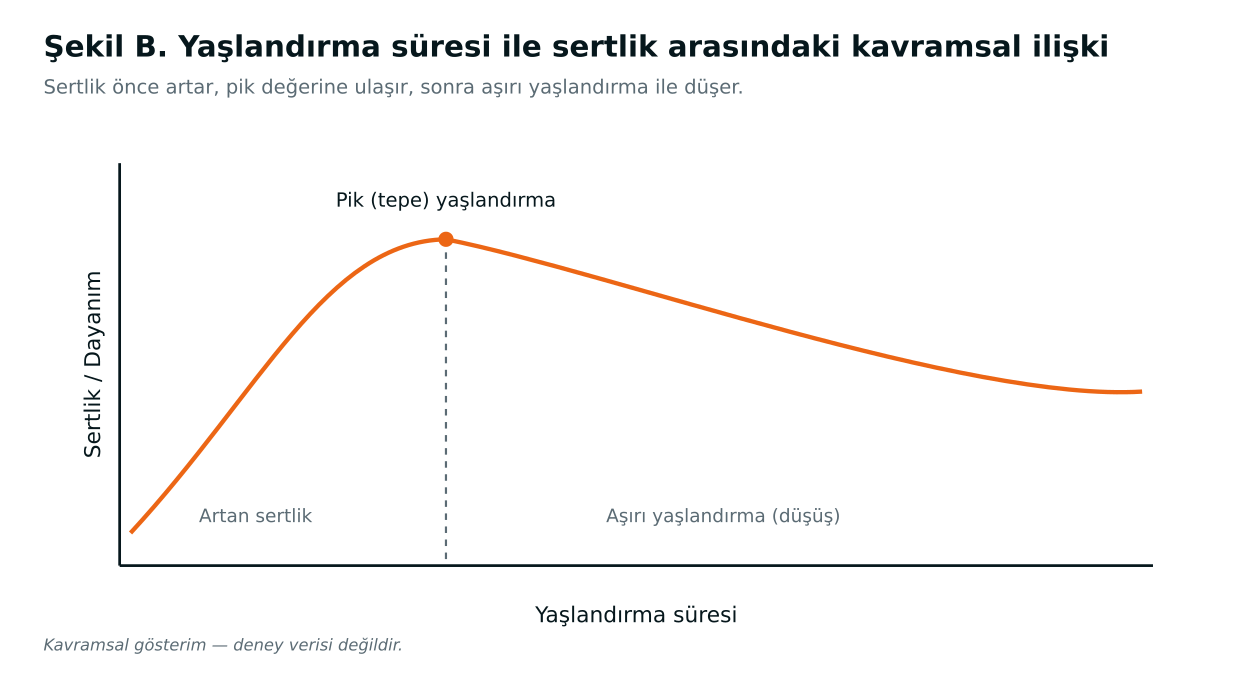
During ageing, as time increases, hardness and strength first rise rapidly, reach a peak value, and then decrease [1, 8]. In the peak region, the fine precipitate structure that most effectively hinders dislocation movement dominates. Ductility, on the other hand, decreases in the region where strength increases; there is a balance between peak strength and ductility.
This behaviour shows that the statement “as ageing time increases, strength rises without limit” is incorrect [1]. Temperature and time are selected according to the targeted strength-ductility balance. In the same alloy, different ageing conditions can produce different service performances (for example, whether high strength or toughness is the priority).
18. Over-Ageing and Loss of Properties
After the peak ageing point is passed, the precipitates coarsen, decrease in number and their effectiveness in hindering dislocations decreases; this stage is called over-ageing and hardness/strength decrease [1, 8]. The point to note is that over-ageing is not always an “error”: in the T7 temper condition, over-ageing is applied deliberately in order to gain dimensional stability and high-temperature strength (Section 10). In other words, depending on the purpose of application, over-ageing can be either an error (unwanted loss of properties) or a controlled stabilisation step.
19. Importance of Casting Quality Before Heat Treatment
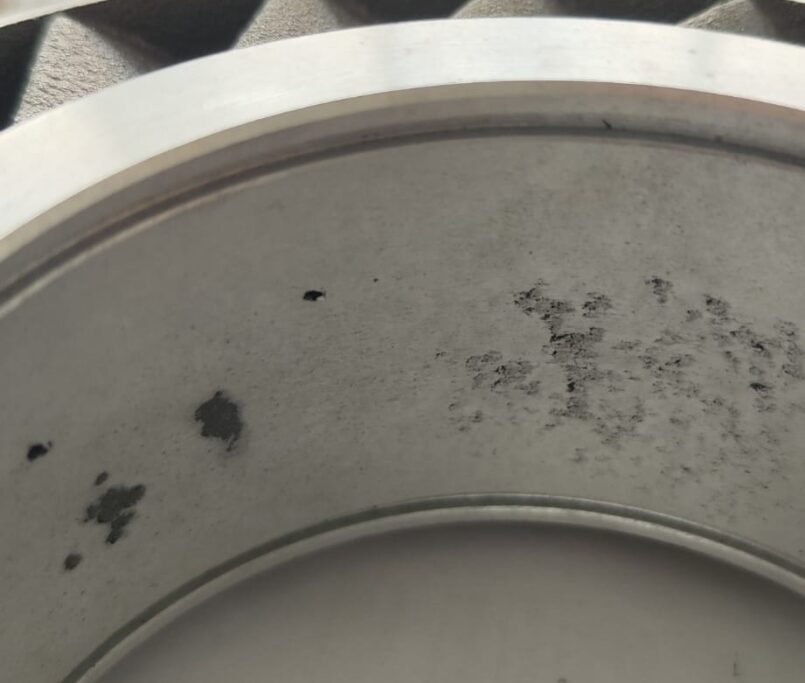
The success of heat treatment depends largely on casting quality before heat treatment [2]. High temperature does not heal defects left over from casting; on the contrary, it can make them more visible (for porosity see Porosity in Aluminium Casting):
- Gas porosity: gas cavities near the surface can expand at high temperature and create blistering at the surface.
- Shrinkage cavities: cannot be eliminated by heat treatment; they must be prevented during casting by feeding.
- Oxide films (bifilm)/inclusions: do not disappear and limit mechanical properties.
- Acicular Fe intermetallics: form during slow cooling; cannot be completely eliminated by heat treatment.
For this reason heat treatment cannot replace casting quality; it complements it. A quality casting and correct heat treatment must be considered together [2].
20. Quality Control After Heat Treatment
Verification of heat treatment requires the combined evaluation of process parameter monitoring and result measurements. General quality control methods are as follows (related infrastructure: Laboratory and Quality Control):
- Alloy chemical composition: verified by methods such as optical emission spectrometry (spark-OES). Critical note: spark-OES measures chemical composition; it does not directly measure mechanical strength after heat treatment.
- Process tracking: solution treatment/ageing temperature-time records and quenching conditions.
- Hardness measurement: Brinell/Rockwell/Vickers, a quick indicator of the heat treatment response.
- Tensile test: yield/tensile strength and elongation are decisive in verifying the temper.
- Dimensional control: critical for quenching-induced distortion.
- Microstructural examination: for eutectic Si morphology, precipitate structure and traces of incipient melting.
Also: the RPT (Reduced Pressure Test) is a test used to evaluate the gas and porosity tendency of a liquid aluminium sample by solidifying it under reduced pressure. Together with hydrostatic density measurement, it can support the evaluation of the density index. It is not a radiographic examination and is not used as a direct test for verifying heat treatment temper.
21. Practical Engineering Considerations for Aluminium Sand Casting
The specific conditions of aluminium sand casting directly affect heat treatment decisions [1, 7]:
- Coarse structure → longer solution treatment: because the dendritic structure is coarse due to slow cooling, the solution treatment time is generally kept longer for homogenisation.
- Temper selection against distortion risk: for parts with tight dimensional tolerances, T5, which does not involve quenching, may be preferred.
- Section thickness: thick regions cool more slowly; this affects both solution treatment and quenching behaviour.
- Alloy selection: the applicability of the desired temper depends on whether the alloy exhibits a solvus.
- Integrity of casting + heat treatment: porosity and shrinkage control must be resolved at the casting stage; heat treatment does not compensate for them.
- Part-specific optimisation: temperature-time values must be determined with the alloy, geometry and verification tests; an unverified temperature-time pair should not be recommended as a production recipe [9, 10].
22. Frequently Asked Questions (FAQ)
Does heat treatment eliminate porosity in the casting?
No. Heat treatment does not eliminate gas porosity or shrinkage cavities; it can cause gas cavities near the surface to form blisters [2].
What is the main difference between T5 and T6?
T5 includes only artificial ageing after cooling from casting (a high-temperature production process); there is no separate solution treatment/quenching step. T6 includes the full solution treatment + quenching + artificial ageing; it generally offers higher strength, while T5 offers a lower risk of distortion [1, 6, 11].
Can T6 be applied to every aluminium alloy?
No. T6 can only be applied to alloys that exhibit a solvus (hardenable alloys); it is not effective in alloys that do not show classical precipitation hardening [1, 6].
Does strength increase continuously if ageing time is extended?
No. Strength first reaches a peak value, then decreases due to over-ageing [1, 8]. In T7, over-ageing is applied deliberately.
What happens if the solution treatment temperature is too high?
Low-melting phases may locally melt (incipient melting); this leads to permanent and irreparable microstructural damage [9, 10].
23. Conclusion
Heat treatment in aluminium casting is, within the F/O and T1–T10 temper system, a volumetric process that determines mechanical properties through precipitation hardening depending on the solvus behaviour of the alloy. The solution treatment–quenching–ageing chain and the distinction between T5/T6/T7 are not merely a matter of parameter selection; they are an integrated engineering decision that considers casting quality, quenching-induced residual stress and incipient melting risk together. Heat treatment does not replace casting quality; it complements it. Success in aluminium sand casting is achieved by optimising the alloy–geometry–process triad on a part basis and verifying it with hardness, tensile, dimensional and microstructural tests.
24. Maraton Dokum Technical Production Approach
At Maraton Dokum, we carry out heat treatment processes consisting of solution treatment, quenching and ageing steps on our aluminium casting products that exhibit a solvus curve, with a metallurgy and materials engineering approach. Heat treatment parameters are evaluated according to the product strength, hardness and alloy type requested by the customer.
The metallurgical mechanisms, temper conditions and literature findings presented in this article are within the scope of general engineering knowledge; they do not mean that a specific alloy-temper combination or process parameter is directly applied at our company. Application details are clarified through technical evaluation specific to the relevant part and project. For detailed information about our heat treatment service, you can review our Heat Treatment service page.
25. Academic References
- Sigworth, G. K. (2018). *Heat Treatment of Aluminum Alloy Castings*. In ASM Handbook, Vol. 2A: Aluminum Science and Technology (pp. 478–492). ASM International. https://doi.org/10.31399/asm.hb.v02a.a0006507
- ASTM International. (2025). *ASTM B917/B917M-25: Standard Practice for Heat Treatment of Aluminum-Alloy Castings From All Processes*. ASTM International, Book of Standards Vol. 02.02. https://doi.org/10.1520/B0917_B0917M-25
- Scharf, S., Bergedieck, N., Riedel, E., Richter, H., & Stein, N. (2020). *Unlocking Sustainability Potentials in Heat Treatment Processes*. Sustainability, 12(16), 6457. https://doi.org/10.3390/su12166457
- Long, H. C., Chen, J. H., Liu, C. H., Li, D. Z., & Li, Y. Y. (2013). *The negative effect of solution treatment on the age hardening of A356 alloy*. Materials Science and Engineering: A, 566, 112–118. https://doi.org/10.1016/j.msea.2012.12.093
- Ibrahim, M., Abdelaziz, M., Samuel, A., Doty, H., & Samuel, F. (2021). *Spheroidization and Coarsening of Eutectic Si Particles in Al-Si-Based Alloys*. Advances in Materials Science and Engineering, 2021, 6678280. https://doi.org/10.1155/2021/6678280
- The Aluminum Association. (2024). *American National Standard Alloy and Temper Designation Systems for Aluminum* (ANSI H35.1/H35.1M-2024). The Aluminum Association, Arlington, VA.
- Sjölander, E., & Seifeddine, S. (2010). *The heat treatment of Al–Si–Cu–Mg casting alloys*. Journal of Materials Processing Technology, 210(10), 1249–1259. https://doi.org/10.1016/j.jmatprotec.2010.03.020
- Sjölander, E., & Seifeddine, S. (2011). *Artificial ageing of Al–Si–Cu–Mg casting alloys*. Materials Science and Engineering: A, 528(24), 7402–7409. https://doi.org/10.1016/j.msea.2011.06.036
- Mohamed, A. M. A., Samuel, F. H., & Al kahtani, S. (2012). *Influence of Mg and solution heat treatment on the occurrence of incipient melting in Al–Si–Cu–Mg cast alloys*. Materials Science and Engineering: A, 543, 22–34. https://doi.org/10.1016/j.msea.2012.02.032
- Samuel, F. H. (1998). *Incipient melting of Al5Mg8Si6Cu2 and Al2Cu intermetallics in unmodified and strontium-modified Al–Si–Cu–Mg (319) alloys during solution heat treatment*. Journal of Materials Science, 33(9), 2283–2297. https://doi.org/10.1023/A:1004383203476
- Rosso, M., Peter, I., & Villa, R. (2008). *Effects of T5 and T6 Heat Treatments Applied to Rheocast A356 Parts for Automotive Applications*. Solid State Phenomena, 141–143, 237–242. https://doi.org/10.4028/www.scientific.net/ssp.141-143.237
- Hegde, S., & Prabhu, K. N. (2008). *Modification of eutectic silicon in Al–Si alloys*. Journal of Materials Science, 43(9), 3009–3027. https://doi.org/10.1007/s10853-008-2505-5